What is Socioliteracy?
Why might two individuals or groups interpret the same data in drastically different ways? According to the Republican Party platform of 2012, “Our nation faces unprecedented uncertainty with great fiscal and economic challenges, and under the current administration has suffered through the longest and most severe economic downturn since the Great Depression” (Republican National Committee, 2013). However, Democrats suggest, “We were in the midst of the greatest economic crisis since the Great Depression, the previous administration had put two wars on our nation’s credit card … today, our economy is growing again, al-Qaeda is weaker than at any point since 9/11, and our manufacturing sector is growing for the first time in more than a decade” (Democratic National Committee, December).
More than 60 years ago, French Nobel laureate Gide wrote: “Croyez ceux qui cherchent la vérité, doutez de ceux qui la trouvent; doutez de tout; mais ne doutez pas de vous-mêmes” (1952, p. 174), or “believe those who are seeking the truth; doubt those who find it; doubt everything, but don’t doubt of yourself.” As a society, we’ve historically viewed knowledge as a commodity, something to create, manage and distribute. But it’s when containment and control remain valued that knowledge oppresses.
As a social activity, where logical debates and personal reflections build on meaning, knowledge is liberation. The dichotomies constructed by preoccupations with binary logic – fact from non-fact, biased from nonbiased – are rusting as relics of broadcast media and print culture, removed from the values seeded in today’s online social networks (Tuominen, Savolainen, & Talja, p. 338). In our information-rich, hyper-connected world, we often find ourselves caught in ever-expanding information-processing loops. Knowing how to read and write isn’t enough. These hard skills are now part of a much larger system of literacy practices, where social contexts evolve understandings and technology.
The Big Bang of Literacy’s Evolution
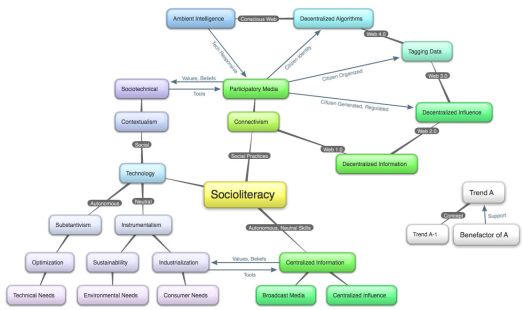
As futurist and writer Alvin Toffler is quoted, “The illiterate of the 21st century will not be those who cannot read and write, but those who cannot learn, unlearn and relearn” (2013). When literacy is defined as events, it follows an autonomous model, which is neutral, decontextualized and universally applicable. As we created books to store knowledge, we constructed bookshelves for their private storage. Libraries were built to hold our ideas within a far bigger private domain, using linear linking systems. And then, it all sort of blew up in an almost big bang-type fashion. The advent of the Internet led to an information explosion, ever-accelerating particles of progress inspired widespread content production, consumption and processing. Cyberspace started presenting a seemingly infinite amount of ideas to the public domain. Everything was accessible from personal devices attached to a nonlinear linking system, the World Wide Web.
Web 2.0 is the big bang of the information age. It’s opening doors to citizen-generated content and citizen-regulated influence. More or less, the Internet ended the era when events connected to content defined literacy. And, it’s the Internet, or an Internet-type system, that’ll propel mankind to its next level of literacy, one dependent on a social context. In 2004, George Siemens put forth a new learning model: “Connectivism is driven by the understanding that decisions are based on rapidly altering foundations. New information is continually being acquired. The ability to draw distinctions between important and unimportant information is vital. The ability to recognize when new information alters the landscape based on decisions made yesterday is also critical” (2004). Connectivism relies on a free flow of information and its synthesis.
As our highly interactive digital groups expand, we’ll continue to express ourselves by coupling reading and writing events with information literacy practices. Our virtual communities serve as extensions to our physical communities; we’re forming meaningful relationships that serve as a relevant source of knowledge. Information literacy is embedded within group activities, practiced by communities using appropriate technologies. Widespread social interactions with knowledge and technology are affecting understandings of our world, and personal identity. With digital media, our focus transitions from real world origins, educational backgrounds and economic statuses to how a person navigates meaning in social systems (Tække, 2011). Billions of personal brands are gaining relevance as roles in shared knowledge define individuals. During the 21st century, practices will supersede events in differentiating literate and illiterate.
The Web will become more productive, as cyberspace retracts for improving sense making. With connectivism maturing, participatory media will force necessary deviations in the Web’s evolution. During Web 3.0, citizens will focus on robust content tagging networks and better-designed algorithms for processing data. Web 4.0 will decentralize algorithms, making everyone’s experience within information technology networks unique and centric on individuality. With nearly infinite data storage and energy capabilities, a predictive and ambient artificial intelligence will lead to what some might consider the Conscious Web. Technology will become responsive, acting as a meaningful contributor to participatory media. Simply knowing how to read and write won’t contribute much meaning to one’s life.
Social Interactions Drive Technology
Mankind’s expressed values and beliefs cause formidable transitions in technology. Our collective knowledge, influenced by countless self-guided, self-disciplined and divergent explorations of ideas, contributes to a sociotechnical system. Technology is assisting us in challenging and changing how we views our world and our position in it. As Tuominen, Reijo and Sanna explained, it’s important to understand the interplay between information technologies, workplace learning and domain-specific knowledge formation processes: “The sociotechnical practice approach sees the information literacy movement to be primarily about enabling groups and communities to cultivate existing information strategies and about supporting them in their interactions with information technologies” (2005, pp. 340-341). The idea that our thinking processes include elements of our social and technological environments is leading to studies of a “Web-extended mind,” where the Web serve as a substrate for human cognition (Smart, 2012).
Like literacy, technology has been thought as neutral and decontextualized and even autonomous. Following the ideas of instrumentalism, we industrialized our tool-making capacity to fulfill consumer and environmental needs. With substantivism, offering a far gloomier outlook, our tools are autonomous; they optimize to meet technical needs beyond human control. Reflecting on the past two decades, Paredis asserted that the prevailing ideas of instrumentalism and substantivism have lost ground (2011), suggesting that it’s becoming well accepted that “technology is neither neutral nor autonomous, but that technology and society simultaneously influence and constitute each other” (p. 209). There are clear examples of this assertion. Driven by our desires for democratization and decentralization, our calls for personal liberties and freedom of expression, our concerns with corruption, participatory media was born.
Technology is contextualized. We don’t accept and develop tools at random. People chose to use a specific technology when they perceive it’ll fulfill a certain need, accomplish a certain task, or achieve a certain goal. It’s part of a sociotechnical process that involves interactions between people and technology. With technology, our values and beliefs materialize to catalyze our culture. Before the Arab Spring, a wave of demonstrations and protests in the Arab World, the global community warned of the region’s deeply engrained nepotism, bribery and patronage. As social media entered the region, protesters used it to keep connected and active, while toppling tyrants. Participatory media has evolved into a front-line information and networking platform that excites activism, and forms a powerful national integrity system.
When information literacy is important, thinking and computers form a cooperative system that nourishes an individual or group’s competence for it. If a teacher today quizzes a student about the atomic number of boron, the student is likely to Google it. Shown answers in a fraction of a second, they confidently respond with the number, and then its symbol, atomic mass, electron configuration. During their sudden search, they may get stimulated with new questions about it’s discovery, or another chemical element, or organic cell compositions.
Using technology, the ability to act as critical and creative thinkers, not only content curators and storage depots, can be nurtured. On the other hand, technology can be used to control, oppress and kill. If you don’t like the evolution of technology, reconsider how you express your values and beliefs. When you log into social media, are you more likely to sustain thoughts or enable thinking? If it’s the latter, you’re part of the socioliteracy movement.
Works Cited
Democratic National Committee. (December, 4 2013). 2012 Democratic National Platform. Retrieved 4 2013, December, from Democrats.org: http://www.democrats.org/democratic-national-platform
Gide, A. (1952). Ainsi soit-il ou Les Jeux sont faits. Paris: Gallimard.
Paredis, E. (2011). Sustainability Transitions and the Nature of Technology. Foundations Of Science , 16 (2-3), 195-225.
Republican National Committee. (2013, December 4). 2012 Republican Platform: Preamble. Retrieved December 4, 2013, from GOP.com: http://www.gop.com/2012-republican-platform_Preamble/
Siemens, G. (2004, December 12). Connectivism: A learning theory for the digital age . Retrieved October 20, 2013, from elearnspace.org: http://www.elearnspace.org/Articles/connectivism.htm
Smart, P. (2012). The Web-Extended Mind. Metaphilosophy , 43 (4), 446-463.
Tække, J. (2011, April). Media as the Mechanism Behind Structural Coupling and the Evolution of the Mind. Retrieved November 19, 2013, from Jesper Tække: http://pure.au.dk/portal/files/35259305/Dubrovnik_Taekke.pdf
Toffler, A. (2013, December 4). Toffler Quotes. Retrieved December 4, 2013, from Alvin and Heidi Toffler: http://www.alvintoffler.net/?fa=galleryquotes
Tuominen, K., Savolainen, R., & Talja, S. (2005). Information literacy as a sociotechnical practice. 75 (3), 329-345.


 Socioliteracy