Navigate Four Dialogue Fields Online
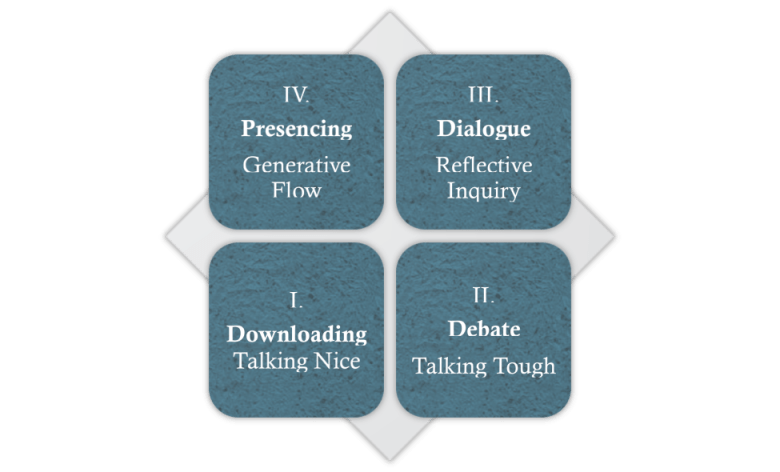 Dialogue is taking place everywhere, anytime. Scharmer identified four fields of conversation to illustrate the path people take toward conversational flow (2009, p. 236). Before that flow can occur, a container must be created for which dialogue may emerge. Conversations often start with downloading, where a relationship is established based on politeness and empty phrases. People choose words that worked well in the past, using assumptions without a commitment to understanding. Debate takes place when people defend their ideas, sharing what they think. Dialogue begins when people transcend the conversational container established with debate. They open up to new, collaborative understandings. They start seeing themselves as part of a system of inquiry, rather than a self-centered exhibit of ideas. With presencing, people start sharing within evolving understandings. A generative flow unfolds, unleashing a collective creativity through authentic and shifting identities. How might this process relate to online conversations, and how can understanding it help school districts? To lead change, we must recognize these patterns of conversation online.
I. Downloading
When the energy invested into a relationship is low, people conform. To attract such conversations, social media managers only need to conform to prevailing views. According to Scharmer, much of how we communicate is based on habitual patterns of action and thought (2009, p. 119). When facing a familiar situation, we tend to act in a familiar way. Hampton et al. analyzed 269 random Facebook users and found people like to “like” content (2012). A third of their sample clicked “like” at least once per week, and slightly more had their own content liked by a friend. Clicking “like” on Facebook or Pinterest, or “favorite” on Twitter, is a passive action that brands a person with existing ideas. Their association is shared among their social networks, while keeping the doors to dialogue shut. To truly build understandings and affect public opinion, those doors must eventually open. In District 49, we look for ways to pose a question with Facebook updates, or inspire dialogue with a short narrative.
To leave the field structure of downloading, dialogue leaders help people start paying attention and open up to new realities. Scharmer says four learning barriers prevent people from seeing their realities (2009, p. 126):
- Not recognizing what you see – To decouple perception and thought, present information in an objective manner that encourages the sharing of perspectives and collaboration. When sharing an event, ask how it might benefit a community.
- Not saying what you think – To decouple thinking and talking, present information that encourages people to discuss how their ideas are connected to their experiences. Encourage divergent opinions on topics, while clearing up misunderstandings.
- Not doing what you say – To decouple talking and “walking,” provide ways for patrons to act on their social media contributions. If a community rallies around an idea, clicking “like” and “favorite,” suggest a way to act on that positive momentum.
- Not seeing what you do – To decouple perception and action, eliminate the blind spots that prevent your patrons from accepting reality. Blind spots keep people from appreciating complexities and disruptions in thinking. It may be as simple as providing more context, or require the hosting of a reliable problem-solving activity that creates a sense of sustained partnership.
II. Talking Tough
During confrontation, the energy invested into a relationship increases. Dialogue leaders must methodically keep emotionally challenging situations from resulting in conversational breakdowns. Just as downloading relies on conforming, debate depends on a desire to take a stance. When people feel comfortable with speaking their mind, debates are invigorated by views that challenge common perceptions. Within the structure of debate, people start arguments to beat or best opposing views. Debate is useful, because different views are expressed and a conversational container is created. By welcoming conflicting opinions, collaboration is seeded. Moreover, by hosting tough talkers, public relations practitioners prove they’re not in the business of censorship, or advocating a false sense of achievement. The best tool to eliminate rivalry is truth. When communities divide, they form rallying points for doubt and error. When truth is evident, factions fall. Nobody disputes whether there is daylight at noon. A long dispute may suggest both parties are wrong.
Correa, Hinsley and de Zúñiga found emotional instability predicts regular social media use, especially by men (2010). Compelling evidence also implies neurotic people tend to prefer asynchronous forms of online communication (Ryan & Xenos, 2011). It’s likely related to a sufficient time to respond. Since neuroticism is linked to loneliness, it’s likely that anxious and nervous people use social media to seek support and company. With the right leadership they’ll join a culture of inquiry. Debate won’t carve a path to conversational breakdowns; it’ll create a container for emerging understandings. To facilitate a move away from the boundaries of “My Position,” Scharmer says people must feel safe to change their point of view (2009, p. 274). Bohm suggests helping them suspend their view: “so that you neither carry them out nor suppress them. You don’t believe them, nor do you disbelieve them; you don’t judge them as good or bad” (2004, p. 23). Online conversations sometimes carry a feeling of group therapy. It may be helpful to collaborate about a set of conduct norms, such as no content that’s intimidating, or harassing; hate speech, threatening, or pornographic; incites violence; contains nudity or graphic or gratuitous violence; or encouraging anything unlawful, misleading, malicious or discriminatory.
III. Reflective Dialogue
When a community moves from talking tough to reflection, they slow down and pull away from owning their point of view. Hampton et al. found the longer someone uses Facebook, the more frequently they interact with content (2012). What’s more, there’s a subset of Facebook users who are disproportionately more active. While only 5 percent of power users use all the communication tools – sending friend requests, pressing the “like” button, sending private messages, tagging friends in photos – about 20-30 percent specialize in one activity. On average power users are most likely to comment. Correa et al. noticed increased social media use in extraverted people, particularly those open to new experiences (2010). Ryan & Xeno support the claim that Facebook users tend to be extraverted, as well as exhibit higher levels of total narcissism, exhibitionism and leadership than nonusers (2011). Extraverted people tend to use social networking sites as a means of social extension. To build a culture of inquiry, they must feel safe to question their views and those of others. To dive into deeper layers of conversation people must overcome three barriers: voice of judgment, voice of fear and voice of cynicism (Scharmer, 2009, p. 246).
To fight those voices, dialogue leaders must identify the resistance that keeps conversations from reaching their greatest potential, away from safe phrases or combative listening. All assumptions must be aired with invitations to create new, collaborative understandings. Facilitating a shift to reflective dialogue requires a profound understanding of your community. Why do they refuse to hear a contrary point of view? How can we help them inquire about the point of views of others? How do we encourage empathic listening skills so as to constantly create and evolve a collective effort?
IV. Generative Dialogue
When we truly value a connection, we expend the energy necessary to keep that relationship reflective and generative. We invest a lot of effort to constantly relate and collectively connect. Communal respect thrives in safe environments, where people feel comfortable placing their attention beyond themselves. It leads to creative conversations. According to Scharmer, generative dialogue contributes to two long-term outcomes: “a unique, deep bond among those who participated; and often significant accomplishments by both entire groups and individuals” (2009, p. 280). People obtain a long-lasting quality of connection.
Tapping into presencing, a uniquely collaborative experience, takes time. But it’ll create a real force in community engagement. In his theory of communicative action, Habermas says every act of speech that strives for mutual understandings consists of three validity claims: truth, rightness and sincerity (1985, p. 99). Claims of truth must pass the test of continued discourse, as conversationalists carefully examine evidence. Rightness is tested through discussing what we ought to find acceptable, legitimate and moral. Sincerity is confirmed by probing the actions of those sharing their ideas. If people cannot collaboratively test the validity claims, they cannot change their understandings.
Mutual appreciation requires a claim to pass the validation test of each participant in the dialogue process. For that reason, an understanding cannot be reached unless claims are open to vibrant exchanges — debate and inquiry. Additionally, when people stop criticizing their own ideas, they suspend their desire to understand. And an acceptance or blending of ideas requires comfort in the actions the new understanding implies. If someone is spreading rumors, or complicating crisis communications with unconfirmed updates, lead a conversation about the ethical and progressive use of social media.
Works Cited
Correa, T., Hinsley, A. W., & de Zúñiga, H. G. (2010). Who Interacts on the Web?: The Intersection of Users’ Personality and Social Media Use. Computers in Human Behavior , 26 (2), 247-253.
Habermas, J. (1985). The Theory of Communicative Action, Volume 1: Reason and the Rationalization of Society. Boston: Beacon Press.
Hampton, K., Goulet, L., Marlow, C., & Rainie, L. (2012, February 3). Why Most Facebook Users Get More Than They Give. Retrieved April 24, 2013, from Pew Internet and American Life Project: http://www.pewinternet.org/~/media//Files/Reports/2012/PIP_Facebook%20users_2.3.12.pdf
Ryan, T., & Xenos, S. (2011). Who uses Facebook? An investigation into the relationship between the Big Five, shyness, narcissism, loneliness, and Facebook usage. Computers in Human Behavior , 27 (5), 1658-1664.
Scharmer, O. (2009). Theory U, Leading From The Future as It Emerges. San Francisco: Berrett-Koehler Publishers, Inc.

 Socioliteracy