Be Online Leaders, Not Moderators
Everyone is a potential publisher today. As Bohm warns, our explosion of information can seem like a collection of trivial and almost unrelated fragments, possibly a harmful source of confusion and misinformation (2004, p. 2). People are rapidly obtaining, distributing and interpreting data. While participatory media sites allow administrators to remove or hide fragments of user-generated content, those cover ups consistently create more confusion, pushing people toward frustration more than mutual understandings and trust. The goal must not center on acting as a gatekeeper to ideal conversations, but rather a leader of an authentic exchange of ideas. Mutual understandings and trust are critical. With dialogue leaders, online communities accelerate individual appreciation for collaboration, acting as a tool that inspires deeper understandings of ideas. Social media requires online dialogue leaders, not moderators.
The term “moderator” has been used to define those who accept an authoritative role in online communities, weeding out unwanted behaviors. While online moderators may metaphorically hide or delete an opinion, its underlying issue remains. Unless attempts to connect offline are concurrently coordinated, they’ve failed to appreciate and address the situation: someone is upset. Even if a patron of an organization is acting outside a rational context, blocking their adverse opinion motivates their migration to other platforms. Online discussions must display transparency and accountability, exhibiting trustworthy and collaborative discussion. To do that, social media managers must watch how patrons conduct a conversation and offer alternatives and feedback, redirecting their ideas toward new avenues of consideration.
 Dialogue leaders strategically uproot attitudes stuck in past experiences. As leaders, organizations may transition brand adversaries to advocates by encouraging new perspectives. Leaders don’t get caught in “who’s right and who’s wrong” debates. They don’t act presumptuous enough to say, “All is good.” Instead, we explain “All is as little bad as possible,” while continuously delivering extra context until new understandings emerge – using a multimedia approach: news stories, photojournalism, video interviews and so forth. As people sustain interactions under a rational context, as reasonable receivers of new data, they allow a disruption of their existing understandings. Effective online dialogue leaders facilitate the development of mutual understandings and trust, protecting conversations from breakdown. Breakthroughs that redirect public opinion rely on a stream of objective, accurate and timely content. And then, they depend on listening to adjust efforts as needed.
Social Listening
It cannot be overstated: it’s critical for dialogue leaders to pay attention. Anyone invested in reputation management must listen to participatory media, whether reading blogs, story commentaries, Facebook posts or Twitter updates – wherever the Internet holds data that helps harness public opinion. Online conversations quickly reach thousands of people. Hampton et al. found that Facebook users who share with a “Friends of Friends” feature enabled will explain their experiences to a mean average of 156,569 people (2012). The study, combining server logs and survey data, proves that people have a voice that could carry across a population the size of large cities – that’s just Facebook. By hosting an online community, administrators commit to listening.
Dialogue leaders listen to encourage a desire to change, alter opinions and challenge theories (Gunnlaugson, 2013). They fuel an emotional charge, sparking the curiosity needed to recognize problems and inspire a sustained action to solve them. They guide people through creative problem-solving processes, ensuring problems are well defined, neither too narrow nor too broad. With a properly stated challenge, they help find facts, form ideas and discover solutions. Successful leaders dissolve the fears inhibiting creativity. They clear up ambiguous and false statements. They inspire divergent thinking, keeping thoughts flexible. They make the familiar strange, exhibiting a genuine and contagious respect for fresh interpretations and innovative ideas. They support the traits of an objective, open-minded observer, and not a protective participant. They encourage an acceptance of new possibilities and improved collaboration, while reducing anxiety about breaking habits. Appreciating creative solutions to problems requires a tolerance to risk, so leaders help people rationalize how both failures and successes are acceptable, each offering teachable opportunities. They promote a culture where ideas evolve and new evidence is explored. Improving understandings through reflective and generative dialogue is their ultimate goal.
 As explained by Gunnlaugson, dialogue coaching involves five key processes: listening, mirroring, summarizing, questioning and catalyzing (2013). Coaches listen to gauge understandings, and mirror situations and conclusions. By summarizing conversations, they inspire people to appreciate their positions. Questioning helps propel the process, imparting opportunities to re-examine assumptions and challenge thinking, while calling for clarity and insight. Coaches provoke comprehensive conclusions or alternative perspectives by pointing at a situation from different viewpoints. They catalyze conversations by exciting passion. It all starts with listening.

Crawford outlines three modes of online listening: background listening, reciprocal listening and delegated listening (2009, p. 526). Background listening is “tuning in” to the constant flow of information, becoming aware of the patterns of speech, activity and thought (p. 528). Organizations may gain access to a sense of intimacy once reserved for close friends and family. Listen to pronoun and verb choices to discover feelings of anger or sadness, pleasure or resentment. Reciprocal listening occurs when we respond to comments and direct messages (p. 530). This type of interaction is what truly separates participatory media from broadcast, as the latter leaves no room for conversations with patrons. People who routinely attack an organization’s credibility are often seeking a sense of acknowledgement. Lastly, delegated listening is a mode when the organization is perceived as listening, while not investing the time required to remain fully present (p. 531). This outsourced form of listening keeps conversations moving through the organization, without a direct connection. An organization should empower its brand advocates to ask questions. It might leverage leaders from community engagement groups, ensuring patrons feel heard. Various social media listening software is also available, like Social Mention. HootSuite sends Twitter alerts based on keywords and locations of tweets. A timely response to a concern shows a powerful commitment to listening.
Listening also involves identifying digital influencers. Social media allows anyone to drive action. It democratizes information, therefore influence, too. Klout is an online service that measures influence across social networks. Klout Scores, a number between one and 100, places a metric on how people impact those connected to them. It also allows an organization to pinpoint the moments when its content influenced people.
 Patron Actions
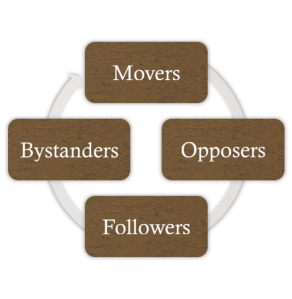
Dialogue leaders keep harmony and productivity within a group discussion, thereby supporting the emergence of generative actions. Kantor’s four-player conversation model suggests actions a person may take during a conversation: movers initiate ideas and transition the conversation; opposers challenge ideas and the conversation; followers complete ideas and support the conversation; bystanders provide perspective on the ideas and conversation (The Kantor Institute, 2013). Movers and opposers are the actors best suited to set direction. The mover is like a skipper charting new waters, while the opposer drops anchors to explore the current waters. Bystanders and followers mostly provide crew support. When a compelling perspective is voiced in online conversations, a pause in posting sometimes occurs, opening a door for actors to change roles. Followers are least relevant in asynchronous online communications, since there’s adequate time to respond and an accessible archive of ideas.
Works Cited
Bohm, D. (2004). David Bohm on Dialogue. (L. Nichol, Ed.) New York: Routledge.
Crawford, K. (2009). Following You: Disciplines of Listening in Social Media. Continuum: Journal of Media and Cultural Studies , 23 (4), 525-535.
Gunnlaugson, O. (2013, April 27). Dialogue Processes, University of Massachusetts. Boston.
Hampton, K., Goulet, L., Marlow, C., & Rainie, L. (2012, February 3). Why Most Facebook Users Get More Than They Give. Retrieved April 24, 2013, from Pew Internet and American Life Project: http://www.pewinternet.org/~/media//Files/Reports/2012/PIP_Facebook%20users_2.3.12.pdf
The Kantor Institute. (2013, April 27). Theory and Change. Retrieved April 27, 2013, from KantorInstitute.com: http://www.kantorinstitute.com/fullwidth.html

 Socioliteracy